Ever stared at your phone’s SIM tray and wondered, “Do I really need to poke this tiny hole every time I switch carriers?” You’re not alone. Millions of travelers and tech enthusiasts are caught in the eSIM vs physical SIM debate, unsure which option actually makes their lives easier.
I’ve tested both extensively across continents and carriers, and I’m about to save you hours of research.
Whether you’re planning international travel or simply upgrading your device, understanding the practical differences between eSIM and physical SIM technology will help you avoid costly mistakes and connection headaches.
But here’s what most comparison articles won’t tell you about why one option might be dramatically better for your specific situation…
Understanding SIM Technology Basics
What is a Physical SIM Card?
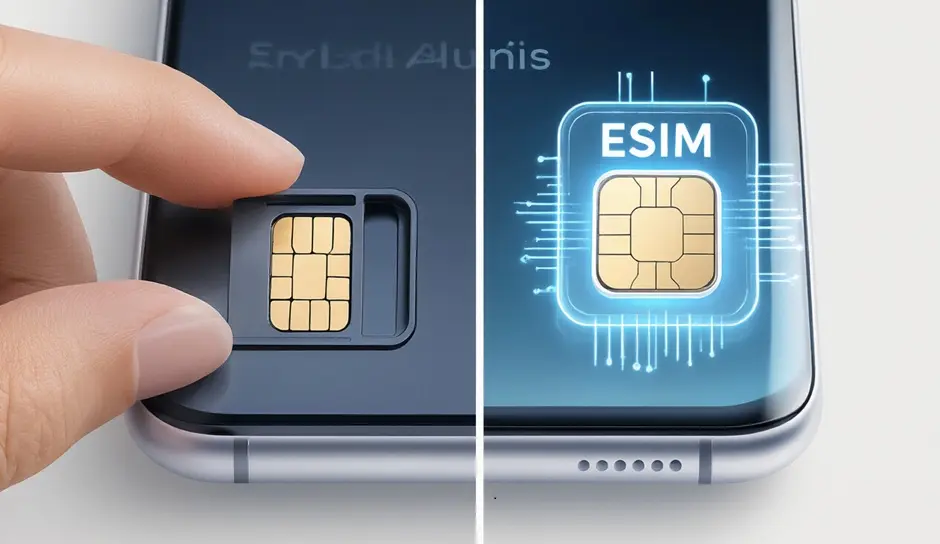
That little plastic chip you’ve been popping in and out of phones for years? That’s your physical SIM (Subscriber Identity Module) card. It’s basically a tiny memory card that stores your phone number and carrier details.
Physical SIMs come in different sizes – from the original full-size cards (rarely seen nowadays) to mini, micro, and the tiny nano-SIMs most phones use today. Each time phones got smaller, SIM cards had to shrink too.
When you switch phones or carriers, you’re dealing with that familiar ritual: find the SIM tray, poke it with that easily-lost ejector tool, and carefully swap the tiny chip without dropping it.
What is an eSIM?
eSIM is exactly what it sounds like – an electronic SIM. There’s no physical card to insert or lose. It’s actually a small chip permanently installed inside your device.
The game-changer? You can activate an eSIM by simply scanning a QR code or using your carrier’s app. No more waiting for a physical card to arrive in the mail or visiting a store.
Even cooler – your phone can store multiple eSIM profiles simultaneously. That means you can have your personal number and work number on one device, or easily switch to a local carrier when traveling without the SIM-swapping dance.
How Both Technologies Connect Your Device
Both physical SIMs and eSIMs do the same core job – they authenticate your device on your carrier’s network.
Think of them as your phone’s ID card. When you power up your device, the SIM (physical or embedded) sends your unique identification number to the carrier, which checks if you’re a paying customer and then grants network access.
The real difference is in how they’re provisioned. Physical SIMs come pre-loaded with your carrier information. With eSIMs, this information gets downloaded wirelessly to your device.
Many newer phones support both technologies simultaneously, giving you the flexibility to use whatever works best for your situation.
Key Differences Between eSIM and Physical SIM
A. Size and Form Factor Comparison
Physical SIMs are those little plastic cards you’ve been popping in and out of phones for years. They’re about the size of your fingernail (12.3 x 8.8mm for a nano-SIM) and while that seems tiny, in the world of modern smartphones, that’s valuable real estate.
eSIMs, on the other hand? They’re built right into your device. No physical card, no swapping, no tiny slot that collects pocket lint. They take up about 90% less space than traditional SIM cards, which means phone manufacturers can use that space for bigger batteries or new features instead.
B. Installation and Activation Process
Remember the last time you got a new phone? You probably had to:
- Find that SIM ejector tool (or bend a paperclip)
- Poke the tiny hole to open the SIM tray
- Carefully place your physical SIM in the slot
- Push it back in and hope everything works
With eSIMs, it’s dramatically different. You simply scan a QR code provided by your carrier, follow a few on-screen prompts, and you’re connected. No physical swapping required. The whole process takes minutes instead of requiring a store visit or waiting for mail.
C. Storage Capacity for Carrier Profiles
One of the coolest things about eSIMs is their ability to store multiple carrier profiles simultaneously. Most eSIM-capable devices can hold 5-10 different carrier profiles at once. You can have your home carrier, work line, and international travel plans all stored and ready to go.
Physical SIMs? One carrier per card. If you want to switch carriers, you need to physically swap SIMs or use a dual-SIM phone (which still has physical limitations).
D. Device Compatibility Overview
Not all devices are created equal when it comes to SIM technology. Physical SIMs still dominate the market – virtually every phone made in the last 20 years supports them. But the tide is shifting fast.
eSIM support has exploded in recent years:
| Device Type | Physical SIM Support | eSIM Support |
|---|---|---|
| Flagship phones | Nearly all | Most models after 2018 |
| Mid-range phones | All | Growing rapidly |
| Budget phones | All | Limited but increasing |
| Wearables | Very few | Majority of cellular models |
| Tablets | Most | Premium models |
Some newer devices like the iPhone 14 (US models) have even gone eSIM-only, completely eliminating the physical SIM slot.
E. Environmental Impact Assessment
The environmental math is pretty straightforward here. Physical SIMs require:
- Plastic production
- Packaging materials
- Physical shipping
- Eventual disposal
Each physical SIM card might seem insignificant, but with billions of mobile subscriptions worldwide, that adds up to tons of plastic waste annually.
eSIMs eliminate this waste entirely. No plastic, no shipping materials, no disposal concerns. When you upgrade your device or change carriers, there’s no physical waste – just a digital update.
Beyond the cards themselves, the reduced need for in-store activations means fewer car trips to carrier stores, further reducing the carbon footprint of mobile connectivity.
Advantages of eSIM Technology
Easy Remote Activation Without Physical Cards
Gone are the days of waiting for a SIM card to arrive in the mail. With eSIM, you can get connected in minutes, not days. No more digging out that tiny SIM tool or fumbling with microscopic cards.
Want to switch carriers? Just scan a QR code or download a profile. That’s it. No store visits, no shipping delays.
This instant activation is a game-changer for travelers especially. Landing in a new country? Connect to local service before you even exit the plane. No more hunting for SIM kiosks at foreign airports or paying ridiculous roaming fees.
Multiple Carrier Profiles on One Device
This might be the coolest part of eSIM technology. Your phone can store multiple carrier profiles simultaneously. Seriously.
You can have your main personal line, a work line, and even temporary travel plans—all on one device without swapping physical cards. Just toggle between them in settings.
Business travelers love this. Keep your home number active while adding a local line abroad. Take calls from both without carrying two phones or constantly swapping SIMs.
Space-Saving Benefits for Device Manufacturers
Phone manufacturers aren’t adding eSIM support just to be trendy. That SIM card tray takes up valuable real estate inside your device.
Removing physical SIM slots means:
- More room for bigger batteries
- Extra space for advanced camera systems
- Slimmer, more water-resistant designs
It’s no coincidence that watches, tablets, and ultra-thin laptops were early eSIM adopters. When every millimeter counts, ditching the SIM tray makes a huge difference.
Reduced Plastic Waste
Those tiny SIM cards add up to a mountain of plastic waste. Think about it—billions of phones worldwide, each with at least one SIM card that eventually gets tossed.
eSIMs eliminate this waste entirely. No plastic card, no packaging, no shipping materials.
Plus, less electronic waste from SIM card production means fewer chemicals and metals entering landfills. It’s a small change that makes a big environmental impact when multiplied across global smartphone users.
Benefits of Traditional Physical SIM Cards
Widespread Global Acceptance
Physical SIM cards have been around since the 1990s, and that longevity comes with a major perk – they work virtually everywhere. Walk into any mobile store from Manhattan to Mumbai, and they’ll know exactly what to do with that little plastic chip.
This universal acceptance isn’t just convenient – it’s crucial when you’re traveling to countries where newer technologies haven’t fully caught on. Many regions still rely exclusively on physical SIMs, especially in developing markets where the infrastructure for eSIM activation simply doesn’t exist yet.
Even the most basic feature phones accept physical SIMs. Can’t say the same for eSIMs, which require newer, fancier devices.
Easy Transfer Between Different Devices
Got a new phone? Just pop your SIM out and stick it in the new one. Done.
Physical SIMs shine when you need to quickly swap between devices. Your friend’s phone died? Let them borrow your SIM for an emergency call. Your smartphone battery flat? Slide that SIM into your backup phone.
No activation processes. No QR codes. No customer service calls. Just a simple, mechanical switch that takes seconds.
This plug-and-play nature makes physical SIMs incredibly practical for people who switch between multiple devices or need a quick solution during device failures.
No Need for Internet During Initial Setup
The chicken-and-egg problem with eSIMs? You often need internet to set them up – but you need your SIM working to get internet!
Physical SIMs completely bypass this frustrating loop. Your carrier pre-loads all the necessary information directly onto the card. Just insert it, and you’re connected to the cellular network immediately.
This becomes particularly valuable during power outages, natural disasters, or when traveling to a new country. You can land at an airport, insert a local SIM, and immediately make calls without hunting for WiFi first.
Practical Considerations for Users
International Travel Convenience
Gone are the days of hunting for a local SIM card at foreign airports. With an eSIM, you can line up your travel connectivity before you even pack your bags. Just scan a QR code, and boom – you’re connected in your destination country.
Physical SIMs still rule in countries where eSIM adoption lags. Many travelers carry a collection of physical SIMs from different countries like badges of honor. But juggling tiny plastic cards and needing a pin tool? Not exactly convenient when you’re rushing between flights.
The killer advantage of eSIMs? Multiple profiles on one device. You can keep your home number active while adding a local data plan – no need to choose between staying reachable and avoiding roaming fees.
Switching Between Carriers
Physical SIMs make you do the legwork. You wait in line, fill out forms, and sometimes pay activation fees just to switch carriers. The eSIM approach? A few taps on your screen and you’re done.
Want to test different networks before committing? eSIMs let you switch between carriers like changing TV channels. No hardware swaps required.
Device Loss or Theft Scenarios
When your phone gets stolen with a physical SIM, thieves can pop it out in seconds, cutting you off completely. With eSIM, the connection is embedded in your device, making immediate misuse harder.
Recovery is where eSIMs truly shine. You can deactivate your stolen device remotely and activate your profile on a new device almost instantly. No waiting for a replacement SIM to arrive in the mail.
Backup and Security Features
Physical SIMs offer a tangible backup – you can literally keep your spare SIM in your wallet. But eSIMs enable digital backups of your profile that can be restored to any compatible device.
Security-wise, eSIMs reduce the risk of SIM swapping attacks since there’s no physical card to duplicate. The digital verification process adds layers of security that plastic cards simply can’t match.
Some providers now offer emergency backup features for eSIMs, allowing limited connectivity even when your account runs out of credit – a potential lifesaver in urgent situations.
Making the Right Choice for Your Needs
Best Use Cases for eSIM
eSIMs shine when you’re constantly on the move. Traveling internationally? You can switch carriers without hunting down a physical SIM shop in a foreign country. Just scan a QR code from your hotel WiFi, and boom – you’re connected.
Digital nomads swear by eSIMs. Imagine landing in Thailand on Monday and Japan on Thursday without juggling tiny plastic cards or needing that annoying little metal pin thingy.
eSIMs also make perfect sense for a lot of devices and wearables where space is tight. Your Apple Watch or smart tracker can stay connected without sacrificing precious real estate for a SIM tray.
When Physical SIMs Still Make Sense
Got an older phone? Then physical SIMs are your only option. Not every device supports eSIM technology yet.
Physical SIMs win for simplicity too. Anyone can pop out a SIM card and put it in another phone. No activation codes, no scanning, no technical headaches.
Some smaller carriers haven’t jumped on the eSIM bandwagon. If you’re loyal to a regional provider, you might still need that plastic card.
Dual SIM Possibilities
The secret superpower many don’t realize? You can run both SIM types simultaneously.
Modern phones let you keep a physical SIM installed while activating an eSIM. This opens up sweet possibilities:
- Work line + personal line on one device
- Local data plan + home country number while traveling
- Different carriers for better coverage depending on location
- Backup connectivity if one network goes down
Future-Proofing Your Mobile Setup
The mobile world is clearly moving toward eSIM dominance. Apple’s iPhone 14 models in the US are already eSIM-only with no physical SIM tray.
Major carriers are pushing digital adoption hard, with some offering incentives to make the switch. The writing’s on the wall.
Smart move? Keep your main number on a physical SIM while experimenting with eSIM for secondary lines or travel. This gives you flexibility while you get comfortable with the technology.
Eventually, we’ll all go digital. Getting familiar with eSIM activation and management now puts you ahead of the curve when physical SIMs eventually go the way of the headphone jack.
The choice between eSIM and physical SIM ultimately depends on your specific needs and lifestyle. While eSIMs offer greater convenience, flexibility, and space efficiency for device manufacturers, physical SIMs remain widely available and offer simple transferability between devices. Consider factors like your travel frequency, device preferences, and carrier support when making your decision.
As technology evolves, eSIMs are gradually becoming the standard across the mobile industry. Whether you choose to embrace this digital transformation now or stick with traditional physical SIMs, understanding the strengths and limitations of each option will help you make an informed choice that best suits your connectivity requirements and usage patterns.